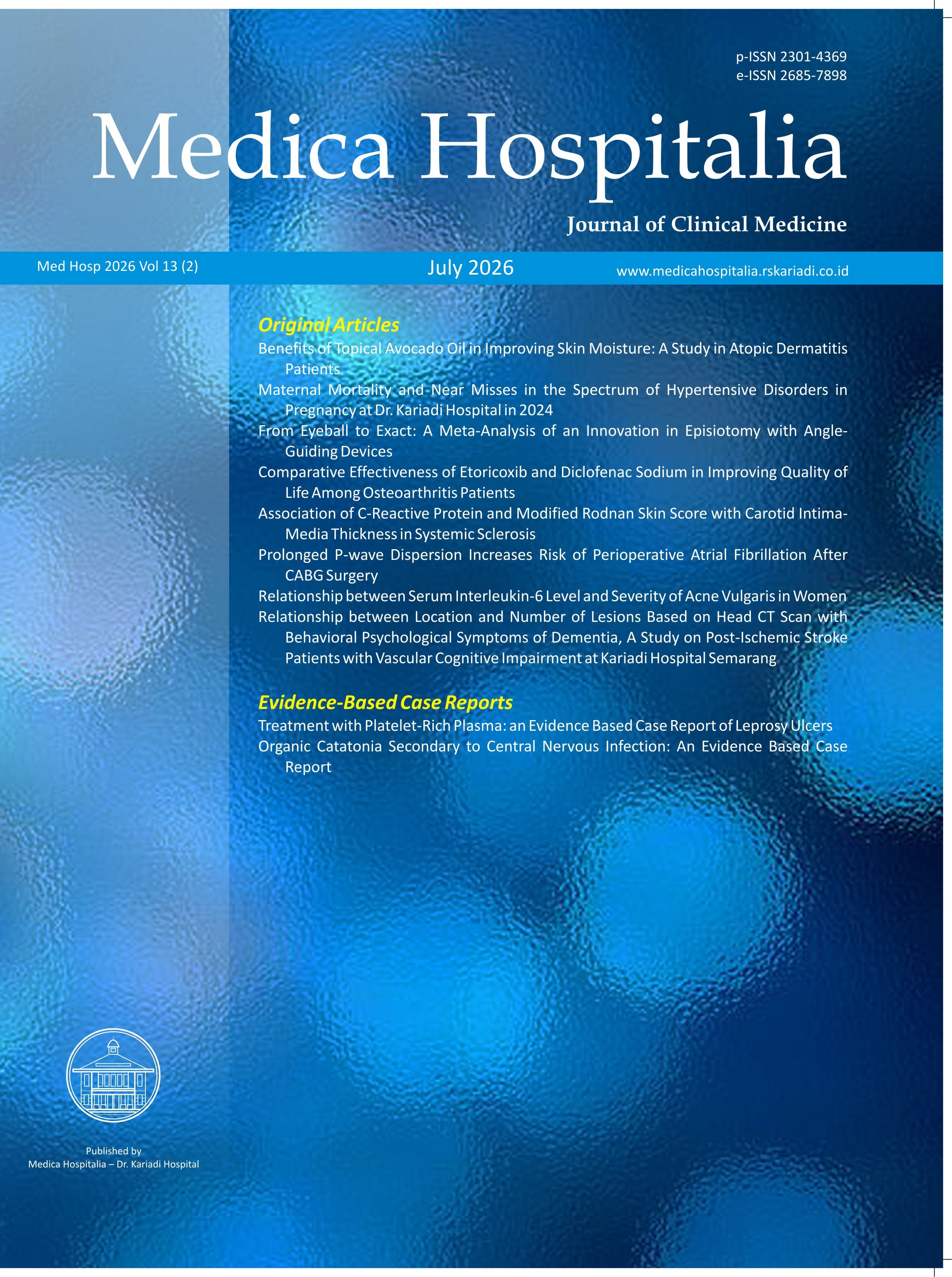
Comparative Effectiveness of Etoricoxib and Diclofenac Sodium in Improving Quality of Life Among Osteoarthritis Patients
DOI:
https://doi.org/10.36408/mhjcm.v13i2.1233Keywords:
Diclofenac Sodium, Etoricoxib, Osteoarthritis, QALYs, UtilityAbstract
BACKGROUND : The effectiveness of etoricoxib versus diclofenac in outpatiens with pain due to osteoarthritis is unclear. There is still debate regarding the relative effectiveness and safety between both in improving the quality of life of OA patients
AIMS :To assess the effectiveness of etoricoxib compared to diclofenac by assessing the quality of life outcomes of Osteoarthritis patients using instruments such as the EQ-5D-5L.
METHOD : Study design using a cross-sectional study design by looking at the results of the quality of life of patients using NSAIDs in the form of diclofenac sodium and etoricoxib.
RESULT : The results showed that moderate positive correlation between etoricoxib or diclofenac sodium therapy in OA patients decreasing utility value ( 0.294; 95% CI = 0.098 - 0.467; p = 0.003). A strong positive correlation was shown between etoricoxib or sodium therapy in OA patients and VAS ( 0.558; 95% CI = 0.402 - 0.682; p = <0.000). These results indicate that each therapeutic use of etoricoxib or diclofenac sodium can improve the utility value or VAS, or conversely.
CONCLUSION : The quality of life value of etoricoxib is better than diclofenac sodium, which is 0.924 and there is a positive correlation between the use of etoricoxib and diclofenac sodium in improving quality of life and VAS values in osteoarthritis patients.
Downloads
References
1. Woolf, A.D. and B. Pfleger, Burden of major musculoskeletal conditions. Bulletin of the world health organization, 2003. 81(9): p. 646-656.
2. Hiligsmann, M., et al. Health economics in the field of osteoarthritis: an expert's consensus paper from the European Society for Clinical and Economic Aspects of Osteoporosis and Osteoarthritis (ESCEO). in Seminars in arthritis and rheumatism. 2013. Elsevier.
3. Carr, A.J., et al., Knee replacement. The Lancet, 2012. 379(9823): p. 1331-1340.
4. Pivec, R., et al., Hip arthroplasty. The Lancet, 2012. 380(9855): p. 1768-1777.
5. Bijlsma, J.W., F. Berenbaum, and F.P. Lafeber, Osteoarthritis: an update with relevance for clinical practice. The Lancet, 2011. 377(9783): p. 2115-2126.
6. Kolasinski, S.L., et al., 2019 American College of Rheumatology/Arthritis Foundation guideline for the management of osteoarthritis of the hand, hip, and knee. Arthritis & rheumatology, 2020. 72(2): p. 220-233.
7. Bannuru, R.R., et al., OARSI guidelines for the non-surgical management of knee, hip, and polyarticular osteoarthritis. Osteoarthritis and cartilage, 2019. 27(11): p. 1578-1589.
8. Nurmesa, A., A. Rachman, and W. Jannah, OVERVIEW PRESCRIBING WITH DUPLICATED NSAID THERAPY WITHOUT GASTRIC PROTECTIVE AGENTS AT A HOSPITAL IN INDONESIA. Jurnal Ilmiah Farmako Bahari, 2024. 15(2): p. 121-126.
9. Nurmesa A, J.W., Rachman A, Risk Factors for the Incidence of Overdose of Etoricoxib Drug in Outpatient at Hospital in Indonesia. IJAClinPharm 2024; 1(1): 37-43., 2024.
10. Purba, F.D., et al., The Indonesian EQ-5D-5L value set. Pharmacoeconomics, 2017. 35: p. 1153-1165.
11. Nurmesa, A., The Impact of Pharmacist Led Interventions on Medication Safety and Clinical Outcomes in Specialized Outpatient Settings: A Scoping Review. Journal of Health Integrated Hospital Practices, 2026. 1(1).
12. Anderson, A.S. and R.F. Loeser, Why is osteoarthritis an age-related disease? Best practice & research Clinical rheumatology, 2010. 24(1): p. 15-26.
13. O’Brien, M.S. and J.J. McDougall, Age and frailty as risk factors for the development of osteoarthritis. Mechanisms of ageing and development, 2019. 180: p. 21-28.
14. Fonseca-Rodrigues, D., et al., Correlation between pain severity and levels of anxiety and depression in osteoarthritis patients: a systematic review and meta-analysis. Rheumatology, 2022. 61(1): p. 53-75.
15. Nurmesa, A., N. Zakiyah, and W.N. Insani, Clinical presentations and characteristics of NSAIDs hypersensitivity in a tertiary care hospital in Indonesia: A case series. International Medical Case Reports Journal, 2025: p. 163-171.
16. Feng, X., et al., Gastrointestinal safety of etoricoxib in osteoarthritis and rheumatoid arthritis: A meta-analysis. PLoS One, 2018. 13(1): p. e0190798.
17. Laine, L., et al., Assessment of upper gastrointestinal safety of etoricoxib and diclofenac in patients with osteoarthritis and rheumatoid arthritis in the Multinational Etoricoxib and Diclofenac Arthritis Long-term (MEDAL) programme: a randomised comparison. The Lancet, 2007. 369(9560): p. 465-473.
18. Trelle, S., et al., Cardiovascular safety of non-steroidal anti-inflammatory drugs: network meta-analysis. Bmj, 2011. 342.
19. Da Costa, B.R., et al., Effectiveness and safety of non-steroidal anti-inflammatory drugs and opioid treatment for knee and hip osteoarthritis: network meta-analysis. bmj, 2021. 375.
20. Shalhoub, M., et al., The impact of pain on quality of life in patients with osteoarthritis: a cross-sectional study from Palestine. BMC musculoskeletal disorders, 2022. 23(1): p. 248.
21. Kawano, M.M., et al., Assessment of quality of life in patients with knee osteoarthritis. Acta ortopedica brasileira, 2015. 23: p. 307-310.
22. Anokye, N.K., et al., Physical activity and health related quality of life. BMC public health, 2012. 12: p. 1-8.
23. Shams, A., S. Poor Hadi, and R. Sahaf, Comparing levels of depression in healthy active and inactive elders versus those with knee osteoarthritis disease. Annals of Applied Sport Science, 2016. 4(1): p. 49-56.
24. Sharma, A., et al., Anxiety and depression in patients with osteoarthritis: impact and management challenges. Open access rheumatology: research and reviews, 2016: p. 103-113.
25. Kontio, T., et al., To what extent is severe osteoarthritis preventable? Occupational and non-occupational risk factors for knee and hip osteoarthritis. Rheumatology, 2020. 59(12): p. 3869-3877.
Additional Files
Published
How to Cite
Issue
Section
License
Copyright (c) 2026 Adi Nurmesa, Dimas Setyadi Putra (Author)

This work is licensed under a Creative Commons Attribution-ShareAlike 4.0 International License.
Copyrights Notice
Copyrights:
Researchers publishing manuscrips at Medica Hospitalis: Journal of Clinical Medicine agree with regulations as follow:
Copyrights of each article belong to researchers, and it is likewise the patent rights
Researchers admit that Medica Hospitalia: Journal of Clinical Medicine has the right of first publication
Researchers may submit manuscripts separately, manage non exclusive distribution of published manuscripts into other versions (such as: being sent to researchers’ institutional repository, publication in the books, etc), admitting that manuscripts have been firstly published at Medica Hospitalia: Journal of Clinical Medicine
License:
Medica Hospitalia: Journal of Clinical Medicine is disseminated based on provisions of Creative Common Attribution-Share Alike 4.0 Internasional It allows individuals to duplicate and disseminate manuscripts in any formats, to alter, compose and make derivatives of manuscripts for any purpose. You are not allowed to use manuscripts for commercial purposes. You should properly acknowledge, reference links, and state that alterations have been made. You can do so in proper ways, but it does not hint that the licensors support you or your usage.