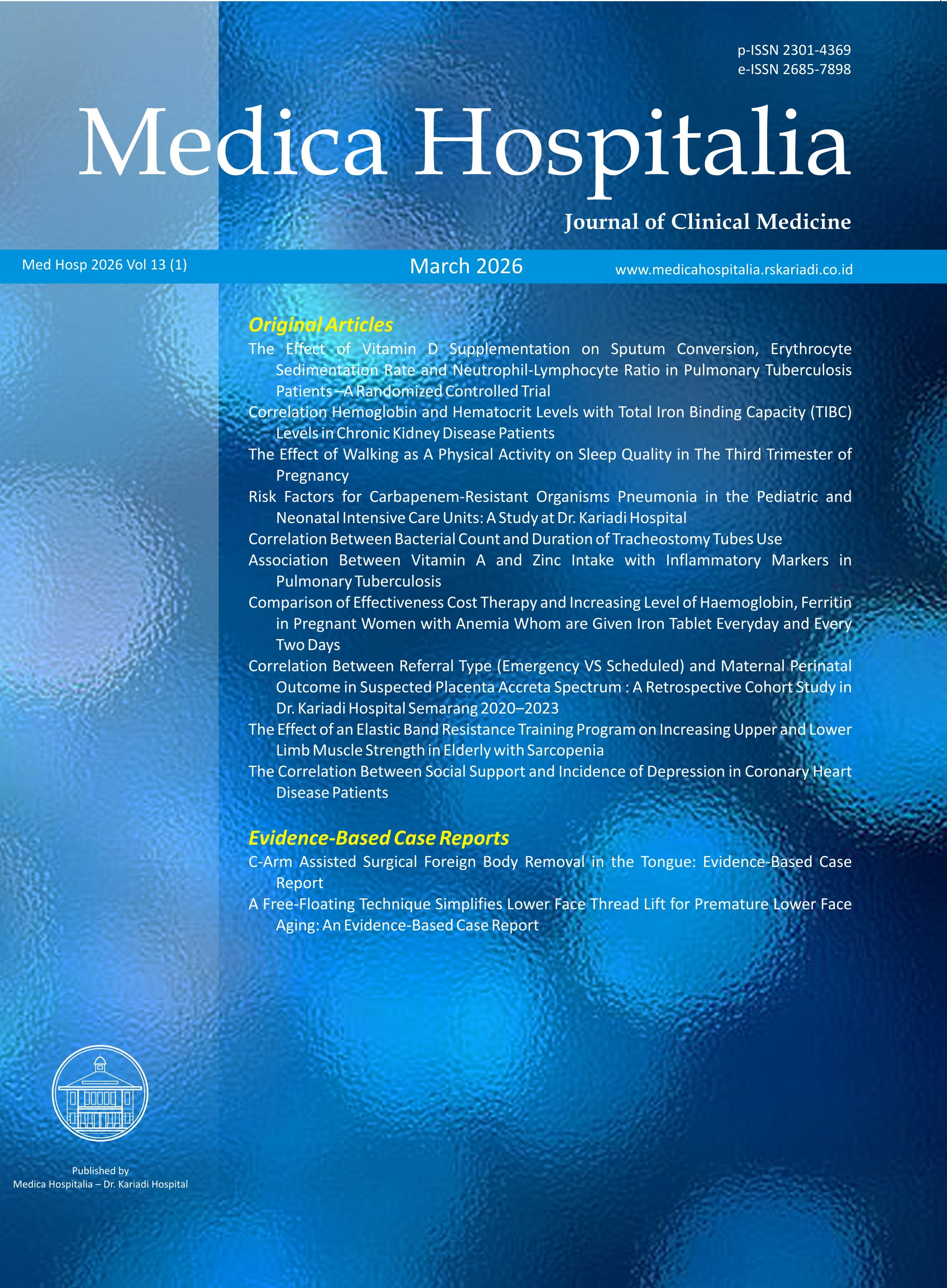
The Effect of Vitamin D Supplementation on Sputum Conversion, Erythrocyte Sedimentation Rate and Neutrophil-Lymphocyte Ratio in Pulmonary Tuberculosis Patients – A Randomized Controlled Trial
DOI:
https://doi.org/10.36408/mhjcm.v13i1.1290Keywords:
Pulmonary Tuberculosis, Vitamin D, Sputum Conversion, Neutrophil-Lymphocyte Ratio, Erythrocyte Sedimentation RateAbstract
BACKGROUND : The health issue of pulmonary tuberculosis (TB) remains a concern in Indonesia. Vitamin D supplementation is one way to manage tuberculosis, which is a crucial case control metric. It is anticipated that vitamin D's anti-inflammatory properties will lower erythrocyte sedimentation rate (ESR) and inflammatory indicators, hence speeding up sputum conversion.
AIMS : To analyze the effect of vitamin D supplementation on sputum conversion, ESR and neutrophil-lymphocyte ratio (NLR) among pulmonary tuberculosis patients
METHOD : Patients with pulmonary tuberculosis who were treated as outpatients at Ulin Banjarmasin Hospital and Pekauman Health Centre between May-July 2024 and who satisfied the study's inclusion requirements were included in the randomised controlled trial. Subjects were randomly divided into 2 groups (19 subjects in the treatment group and 19 subjects in the control group) using random selection with sealed envelopes. The treatment group received antituberculosis drugs (ATD) and vitamin D supplementation at a dose of 10,000 IU/day for eight weeks after the initiation of TB therapy, while the control group received ATD and a placebo. ESR and NLR examinations were performed prior to treatment, in weeks 4 and 8, whereas sputum evaluations were conducted at weeks 2, 4, 6, and 8. Statistical Product and Service Solutions (SPSS) was used for data analysis. P-value <0,05 was significant statistically.
RESULT : The study subjects were 38 pulmonary TB patients, most of whom were women (65.0%) with an average age of 50.42 ± 18.61 years. Overall, during the 8 weeks of intervention, there was a significant effect of vitamin D supplementation on sputum conversion (OR = 1.61, 95%CI = 0.030-0.931, p = 0.037). There was no significant effect of vitamin D supplementation on NLR (regression coefficient = 0.549, 95%CI = -1.769-2.858, p = 0.641) and ESR (regression coefficient = -5.529, 95%CI = -20.658-9.599, p = 0.474).
CONCLUSION : Vitamin D supplementation significantly affects sputum conversion. In the 8th week, almost all subjects who initially had positive BTA became negative. But does not significantly affect ESR and NLR.
Downloads
References
1. Katadata. Ini Provinsi Dengan Kasus TBC Terbanyak Pada 2021. Databoks. 2022.
2. Koleri J, Howady F, Singh J, Balushi S, Maslamani M. Predictors of culture status in patients with persistent smear-positive pulmonary tuberculosis at two months of treatment. BMC Infec Dis. 2026;26 (8):373
3. Shah A, Desai K, Maru A. Evaluation of hematological parameters in pulmonary tuberculosis patients.
4. Haris M, Urip, Danuyanti. Studi Variasi Waktu Pengobatan Pasien TB Paru Terhadap Kadar Hemoglobin Dan Nilai Laju Endap Darah Di Puskesmas Ubung. J Anal Med Biosains. 2017;4(2):111–5. J Fam Med Prim Care. 2022;11(8):4426-30
5. Livranca E, Gunawan L, Ismawatie E. Correlation between leukocyte count and erytgrocyte sedimentation rate in pulmonary tuberculosis patients at Suai Referral Hospital, Timor Leste. J Indon Med Lab Sci. 2025;6(2):147-56
6. Harun H, Nasir M, Sumarni, Wahyuni RD, Aridhatamy D, Pratiwi NA. Neutrophil Lymphocyte Ratio And Acid-Fast Bacilli In Tuberculosis. Indian J Forensic Med Toxicol. 2021;15(1):1091–6.
7. Zeng M, Ran J, Luo Y, Zhou C, Hu Y, Tian X. The potential role and value of vitamin D in the treatment of tuberculosis. Front Cell Infect Microbiol. 2026;15(3):1-8
8. Asemahagn M. Sputum smear conversion and associated factors among smear-positive pulmonary tuberculosis patients in East Gojjam Zone, Northwest Ethiopia: a longitudinal study. BMC Pulm Med. 2021;31(1):118
9. Vo L, Nguyen V, Nguyen N, Dong T, Codlin A, Forse R, et al. Optimising diagnosis and treatment of tuberculosis infection in community and primary care settings in two urban provinces of Viet Nam: a cohort study. BMJ Open. 2023;13:e071537
10. Syahbaa Z, Yuniati S. Comprehensive review of tuberculosis treatment and management: dosage, side effects, and post-treatment. J Diverse Med Res. 2025;2(4):1-9
11. Mamadapur VK, Nagaraju S, Prabhu MM. Comparative Study of Vitamin D Levels in Newly Diagnosed Tuberculosis and a Normal Population. Medicina. 2024;60:685
12. Liu S, lin T, Pan Y. Vitamin D supplementation for tuberculosis prevention: a meta-analysis. Biomol Biomed. 2026;26(4):559-71.
13. Sanlier N, Coskun. Vitamin D, the immune system, and its relationship with diseases. Egypt Pediatr Assoc Gazzette. 2022;70(1):39
14. Siswanto, Sumarno, Jane Y, Widayanti OA, Muktiati NS. Vitamin D as Supportive Treatment Improve The Sputum Conversion and Radiographic Finding in Tuberculosis Patients. J Kedokt Brawijaya. 2009;25(3):128-32
15. Sugiarti S, Ramadhian MR, Carolia N. Vitamin D Sebagai Suplemen Dalam Terapi Tuberkulosis Paru. Majority. 2018;7(2):198–202.
16. Maulidar R, Nurjannah N, Adamy A, Iskandar I. Pengaruh Pemberian Obat Anti Tuberkulosis Dengan Vitamin D Terhadap Perubahan BTA Pada Penderita Tuberkulosis Paru Di Kabupaten Pidie. J SAGO Gizi Dan Kesehat. 2021;2(1):25.
17. Meng J, Li X, Xiong Y, Wu Y, Liu P, Gao S. The role of vitamin D in the prevention and treatment of tuberculosis: a meta-analysis of randomized controlled trials. Infection. 2024
18. Wang J, Feng M, Ying S, Zhou J, Li X. Efficacy and Safety of Vitamin D Supplementation for Pulmonary Tuberculosis: A Systematic Review and Meta-Analysis. Iran J Public Health. 2018;47(4):466-72
19. Riefani S, Juhairina, Isa M, Kusumawardhani E, Haryati H, Nurrasyidah I, et al. Vitamin D, Indeks Massa Tubuh, dan Total Limfosit Hitung pada Pasien Sensitif Obat dan Resisten Obat Penderita Tuberkulosis di Banjarmasin. Jurnal Respirasi (Jurnal Respirologi). Januari 2024, Jil. 10 (01); 14-22
20. Wang SY, Shen TT, Xi BL, Shen Z, Zhang X. Vitamin D Affects The Neutrophil-To-Lymphocyte Ratio in Patients With Type 2 Diabetes Mellitus. J Diabetes Investig. 2021;12:254-65
21. Ganmaa D, Munkhzul B, Fawzi W, Spiegelman D, Willett WC, Bayasgalan P. High-Dose Vitamin D during Tuberculosis Treatment in Mongolia. A Randomized Controlled Trial. Am J Respir Crit Care Med. 2017 Sep 1;196(5):628-637
22. Akbas EM, Gungor A, Ozcicek A, Akbas N, Askin S, Polat M. Vitamin D And Inflammation: Evaluation With Neutrophilto-Lymphocyte Ratio And Platelet-To-Lymphocyte Ratio. Arch Med Sci. 2016;12(4):721–7.
23. Krajewska M, Sedek EW, Ruminska M, Stelmaszczyk A, Sobol M, Majcher A, et al. Vitamin D Effects on Selected Anti-Inflammatory and Pro-Inflammatory Markers of Obesity-Related Chronic Inflammation. Front Endocrinol. 2022;13:920340
24. Sitanggang FT, Simanjuntak JP, Sakdiah S. Vitamin D Deficiency Leukocyte Ratio: Unraveling The Impact On Multidrug Resistant Tuberculosis Patients. Int J Adv Health Sci Tech. 2023;3(6):327-34
25. Jaberi F, Crone C, Lindenstrom T, Arildsen N, Lindelov E, Aagaard L, et al. Reduced vitamin D-induced cathelicidin production and killing of Mycobacterium tuberculosis in macrophages from a patients with a non-functional vitamin D receptor: a case report. Front Immunol. 2022;13(3):1038960
26. Kaya T, Akcay EU, Erturk Z, Ergenc H, Tamer A. The Relationship Between Vitamin D Deficiency and Erythrocyte Sedimentation Rate in Patients With Diabetes. Turkish J Med Sci. 2018;48:424-9
27. Etmainan A, Askari SM, Tahami AN, Mahdi SA, Behzadi M, Shabani M. Relationship Between The Serum Levels of Vitamin D and Inflammatory Markers in ESRD Patients. Acta Biomed. 2020;91(4):e2020099
28. Wijayanthy M, Ratunanda S.Erythrocyte sedimentation rate in new cases of pulmonary tuberculosis patients. Acta Med Health Sci. 2024;3(1):24-30. Available from URL: http://amhs.unjani.ac.id/index.php/acta_medica/article/view/61/45109
29. Brown G, Marchwicka A, Marcinkowska E. Vitamin D and immune system. Adv Food Nutr Res. 2024;109(2):1-41
Additional Files
Published
How to Cite
Issue
Section
License
Copyright (c) 2026 Muchamad Regi Sonjaya, Mohamad Isa, Alfi Yasmina, Isa Ansori, Ira Nurrasyidah, Erna Kusumawardhani (Author)

This work is licensed under a Creative Commons Attribution-ShareAlike 4.0 International License.
Copyrights Notice
Copyrights:
Researchers publishing manuscrips at Medica Hospitalis: Journal of Clinical Medicine agree with regulations as follow:
Copyrights of each article belong to researchers, and it is likewise the patent rights
Researchers admit that Medica Hospitalia: Journal of Clinical Medicine has the right of first publication
Researchers may submit manuscripts separately, manage non exclusive distribution of published manuscripts into other versions (such as: being sent to researchers’ institutional repository, publication in the books, etc), admitting that manuscripts have been firstly published at Medica Hospitalia: Journal of Clinical Medicine
License:
Medica Hospitalia: Journal of Clinical Medicine is disseminated based on provisions of Creative Common Attribution-Share Alike 4.0 Internasional It allows individuals to duplicate and disseminate manuscripts in any formats, to alter, compose and make derivatives of manuscripts for any purpose. You are not allowed to use manuscripts for commercial purposes. You should properly acknowledge, reference links, and state that alterations have been made. You can do so in proper ways, but it does not hint that the licensors support you or your usage.