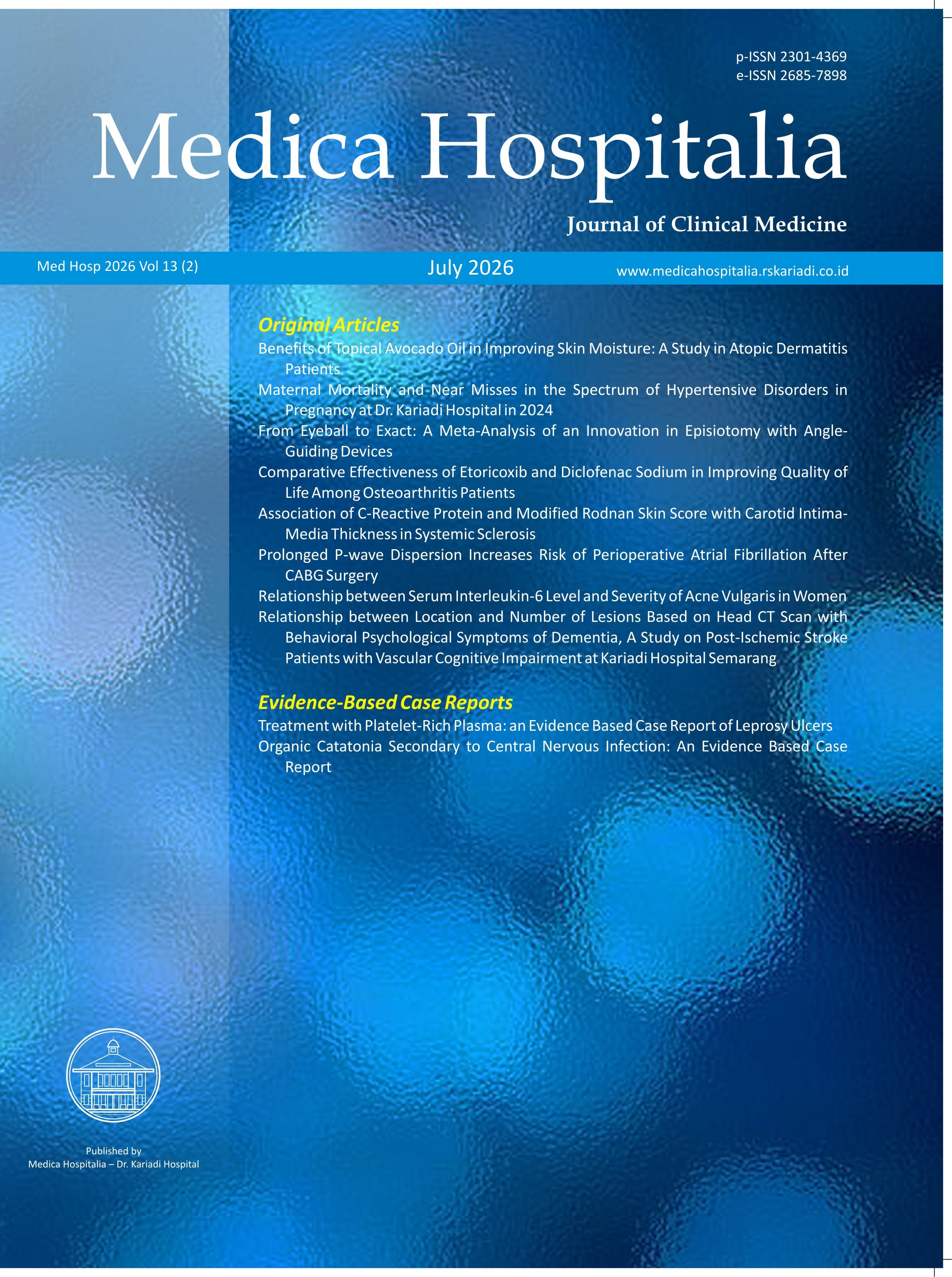
Association Of C-Reactive Protein And Modified Rodnan Skin Score With Carotid Intima-Media Thickness in Systemic Sclerosis
DOI:
https://doi.org/10.36408/mhjcm.v13i2.1471Keywords:
Systemic sclerosis, Skin fibrosis, Common carotid intima-media thickness, C-reactive protein, Modified Rodnan skin scoreAbstract
BACKGROUND: Systemic sclerosis (SSc) is a chronic autoimmune disease characterized by vasculopathy and progressive fibrosis with an increased risk of cardiovascular disease. The common carotid artery intima-media thickness is an indicator of subclinical atherosclerosis and may reflect inflammatory activity in SSc. Quantitative C-reactive protein (CRP) and the modified Rodnan Skin Score (mRSS) are associated with SSc disease activity, although their relationship with common carotid intima-media thickness remains unclear.
AIMS: To evaluate the relationship between quantitative CRP levels and mRSS values with common carotid intima-media thickness in adult patients with SSc.
METHOD: A cross-sectional study was conducted on 26 SSc patients at Dr. Kariadi General Hospital, Semarang. Common carotid intima-media thickness was measured using ultrasonography on both sides. Subjects were categorized based on the presence of intima-media thickening according to the ≥75th percentile for age and sex. Quantitative CRP levels were analyzed using the Mann-Whitney test, while differences in mRSS were analyzed using an independent T-test.
RESULT: Increased common CIMT was observed in 9 patients (34.6%). There was no significant difference in quantitative CRP levels between subjects without and with intima-media thickening (0.40 [0.07–1.10] vs. 0.40 [0.20–0.83] mg/L; P = 0.787). mRSS values also did not differ significantly between the two groups (18.29 ± 9.38 vs. 18.78 ± 12.48; P = 0.912).
CONCLUSION: There was no significant relationship between quantitative CRP levels or mRSS values and common carotid intima-media thickness in patients with SSc. These findings may be influenced by immunosuppressive therapy and study design.
Downloads
References
1. Denton CP, Khanna D. Systemic sclerosis. The Lancet. 2017 Oct 7;390(10103):1685–99. doi:10.1016/S0140-6736(17)30933-9.
2. Bairkdar M, Rossides M, Westerlind H, Hesselstrand R, Arkema EV, Holmqvist M. Incidence and prevalence of systemic sclerosis globally: a comprehensive systematic review and meta-analysis. Rheumatology. 2021 Jul 1;60(7):3121–33. doi:10.1093/rheumatology/keab190.
3. Bergamasco A, Hartmann N, Wallace L, Verpillat P. Epidemiology of systemic sclerosis and systemic sclerosis-associated interstitial lung disease. Clin Epidemiol. 2019;11:257–73. doi:10.2147/CLEP.S191418.
4. Royle JG, Lanyon PC, Grainge MJ, Abhishek A, Pearce FA. The incidence, prevalence, and survival of systemic sclerosis in the UK Clinical Practice Research Datalink. Clin Rheumatol. 2018 Aug;37(8):2103–11. doi:10.1007/s10067-018-4182-3.
5. Allanore Y, Simms R, Distler O, Trojanowska M, Pope J, Denton CP, et al. Systemic sclerosis. Nat Rev Primer. 2015 Apr 23;1:15002. doi:10.1038/nrdp.2015.2.
6. Adigun R, Goyal A, Hariz A. Systemic Sclerosis. In: StatPearls [Internet]. Treasure Island (FL): StatPearls Publishing; 2023 [cited 2023 Oct 18]. Available from: http://www.ncbi.nlm.nih.gov/books/NBK430875/.
7. Pacholczak-Madej R, Kuszmiersz P, Bazan-Socha S, Kosałka-Węgiel J, Iwaniec T, Zaręba L, et al. Endothelial dysfunction in patients with systemic sclerosis. Adv Dermatol Allergol. 2020;37(4):495–502. doi:10.5114/ada.2019.83501.
8. Cutolo M, Sulli A, Smith V. Evaluating microangiopathy in systemic sclerosis: what have we learnt and what is left to discover? Expert Rev Clin Immunol. 2011 Jul 1;7(4):395–7. doi:10.1586/eci.11.35.
9. Patnaik E, Lyons M, Tran K, Pattanaik D. Endothelial Dysfunction in Systemic Sclerosis. Int J Mol Sci. 2023 Sep 21;24(18):14385. doi:10.3390/ijms241814385.
10. Reiss AB, Jacob B, Ahmed S, Carsons SE, DeLeon J. Understanding accelerated atherosclerosis in systemic lupus erythematosus: toward better treatment and prevention. Inflammation. 2021 Oct 1;44(5):1663–82. doi:10.1007/s10753-021-01455-6.
11. Skeoch S, Bruce IN. Atherosclerosis in rheumatoid arthritis: is it all about inflammation? Nat Rev Rheumatol. 2015 Jul;11(7):390–400. doi:10.1038/nrrheum.2015.40.
12. Alenghat FJ. The prevalence of atherosclerosis in those with inflammatory connective tissue disease by race, age and traditional risk factors. Sci Rep. 2016 Feb 4;6(1):1. doi:10.1038/srep20303.
13. McMahon M, Grossman J, FitzGerald J, Dahlin-Lee E, Wallace DJ, Thong BY, et al. Proinflammatory high-density lipoprotein as a biomarker for atherosclerosis in patients with systemic lupus erythematosus and rheumatoid arthritis. Arthritis Rheum. 2006 Aug;54(8):2541–9. doi:10.1002/art.21976..
14. O’Neill SG, Giles I, Lambrianides A, Manson J, D’Cruz D, Schrieber L, et al. Antibodies to apolipoprotein A-I, high-density lipoprotein, and C-reactive protein are associated with disease activity in patients with systemic lupus erythematosus. Arthritis Rheum. 2010 Mar;62(3):845–54. doi:10.1002/art.27286.
15. Moschetti L, Piantoni S, Vizzardi E, Sciatti E, Riccardi M, Franceschini F, et al. Endothelial dysfunction in systemic lupus erythematosus and systemic sclerosis: A common trigger for different microvascular diseases. Front Med [Internet]. 2022 [cited 2023 Oct 18];9. Available from: https://www.frontiersin.org/articles/10.3389/fmed.2022.849086
16. Enocsson H, Karlsson J, Li HY, Wu Y, Kushner I, Wetterö J, et al. The complex role of C-reactive protein in systemic lupus erythematosus. J Clin Med. 2021 Dec 13;10(24):5837. doi:10.3390/jcm10245837..
17. Muangchan C, Pope JE. The significance of interleukin-6 and C-reactive protein in systemic sclerosis: a systematic literature review. Clin Exp Rheumatol. 2013;31(2 Suppl 76):122–34.
18. Khanna D, Furst DE, Clements PJ, Allanore Y, Baron M, Czirjak L, et al. Standardization of the modified Rodnan skin score for use in clinical trials of systemic sclerosis. J Scleroderma Relat Disord. 2017;2(1):11–8. doi:10.5301/jsrd.5000231.
19. Aliielkhchi S, Gerede DM, Esenboğa K, Turgay M, Kiliçkap M. Assessment of subclinical atherosclerosis with carotid intima-media thickness in patients with scleroderma. Genel Tıp Derg. 2022 Feb 28;32(1):61–7. doi:10.54005/geneltip.1029623.
20. Nguyen Thi Phuong T, Dao Thi T, Lundberg IE, Nguyen Huy B. Atherosclerosis in Vietnamese patients with systemic sclerosis and its relationship to disease and traditional risk factors. Rheumatol Adv Pract. 2022 May 6;6(2):rkac048. doi:10.1093/rap/rkac048.
21. Badr El-Din A, El Bakry S, Zaher A, Alhassanein K, Dakrony H, Sayed S, et al. Determinants of atherosclerosis in an Egyptian cohort of systemic sclerosis: Relation to disease activity and severity. Egypt Rheumatol. 2015 Dec 23;38. doi:10.1016/j.ejr.2015.11.003.
22. Schiopu E, Au KM, McMahon MA, Kaplan MJ, Divekar A, Singh RR, et al. Prevalence of subclinical atherosclerosis is increased in systemic sclerosis and is associated with serum proteins: a cross-sectional, controlled study of carotid ultrasound. Rheumatology. 2014 Apr 1;53(4):704–13. doi:10.1093/rheumatology/ket411.
23. Hettema ME, Zhang D, De Leeuw K, Stienstra Y, Smit AJ, Kallenberg CGM, et al. Early atherosclerosis in systemic sclerosis and its relation to disease or traditional risk factors. Arthritis Res Ther. 2008;10(2):R49. doi:10.1186/ar2408.
24. Buelt A, Richards A, Jones AL. Hypertension: New Guidelines from the International Society of Hypertension. Am Fam Physician. 2021 Jun 15;103(12):763–5.
25. Soelistijo SA, Suastika K, Lindarto D, Decroli E, Permana H, Sucipto K, et al. Pedoman Pengelolaan dan Pencegahan Diabetes Melitus Tipe 2 di Indonesia. Jakarta: Perkumpulan Endokrinologi Indonesia; 2024.
26. Aman AM, Soewondo P, Soelistijo SA, Arsana PM, Wismandari W, Zufri H, et al. Panduan Pengelolaan Dislipidemia di Indonesia. 3rd ed. Jakarta: Perkumpulan Endokrinologi Indonesia; 2021.
27. Clements PJ, Lachenbruch PA, Seibold JR, Zee B, Steen VD, Brennan P, et al. Skin thickness score in systemic sclerosis: an assessment of interobserver variability in 3 independent studies. J Rheumatol. 1993 Nov;20(11):1892–6.
28. Asano Y, Jinnin M, Kawaguchi Y, Kuwana M, Goto D, Sato S, et al. Diagnostic criteria, severity classification and guidelines of systemic sclerosis. J Dermatol. 2018 Jun;45(6):633–91. doi:10.1111/1346-8138.14162.
29. Peters SAE, Bots ML. Carotid intima-media thickness studies: study design and data analysis. J Stroke. 2013 Jan;15(1):38–48. doi:10.5853/jos.2013.15.1.38.
30. Touboul P, Hennerici M, Meairs S, Adams H, Amarenco P, Bornstein N, et al. Mannheim carotid intima-media thickness and plaque consensus (2004–2006–2011): an update on behalf of the advisory board of the 3rd and 4th Watching the Risk Symposium 13th and 15th European Stroke Conferences, Mannheim, Germany, 2004, and Brussels, Belgium, 2006. Cerebrovasc Dis Basel Switz. 2012;34(4):290–6. doi:10.1159/000343145.
31. Kwon OC, Han K, Park MC. Sex differences in the risk of incident systemic sclerosis: a nationwide population-based study with subgroup analyses. Sci Rep. 2025 Mar 14;15(1):8803. doi:10.1038/s41598-024-84856-5.
32. Kronzer VL, Bridges SL, Davis JM. Why women have more autoimmune diseases than men: An evolutionary perspective. Evol Appl. 2021 Mar;14(3):629–33. doi:10.1111/eva.13167.
33. Angum F, Khan T, Kaler J, Siddiqui L, Hussain A. The Prevalence of Autoimmune Disorders in Women: A Narrative Review. Cureus. 2020 May 13. doi:10.7759/cureus.8094.
34. Gelber AC, Manno RL, Shah AA, Woods A, Le EN, Boin F, et al. Race and Association With Disease Manifestations and Mortality in Scleroderma: A 20-Year Experience at the Johns Hopkins Scleroderma Center and Review of the Literature. Medicine (Baltimore). 2013 Jul;92(4):191–205. doi:10.1097/MD.0b013e31829be125.
35. Gourh P, Safran SA, Alexander T, Boyden SE, Morgan ND, Shah AA, et al. HLA and autoantibodies define scleroderma subtypes and risk in African and European Americans and suggest a role for molecular mimicry. Proc Natl Acad Sci. 2020 Jan 7;117(1):552–62. doi:10.1073/pnas.1906593116.
36. Stevens B, Abdool-Carrim T, Woodiwiss AJ. Left versus right carotid artery IMT: differential impact of age, gender, and cardiovascular risk factors. Int J Cardiovasc Imaging. 2024 Sep 26;40(11):2391–404. doi:10.1007/s10554-024-03245-1.
37. Kaligis R, Adiarto S, Nugroho J, Pradnyana B, Lefi A, Rifqi S, et al. Carotid Intima-Media Thickness in Indonesian Subjects with Cardiovascular Disease Risk Factors Who Were Not Receiving Lipid-Lowering Agents. Int J Angiol. 2016 Feb 24;25(03):174–80. doi:10.1055/s-0036-1572365.
38. North BJ, Sinclair DA. The Intersection Between Aging and Cardiovascular Disease. Circ Res. 2012 Apr 13;110(8):1097–108. doi:10.1161/CIRCRESAHA.111.246876.
39. Stein JH, Korcarz CE, Hurst RT, Lonn E, Kendall CB, Mohler ER, et al. Use of carotid ultrasound to identify subclinical vascular disease and evaluate cardiovascular disease risk: a consensus statement from the American Society of Echocardiography Carotid Intima-Media Thickness Task Force. Endorsed by the Society for Vascular Medicine. J Am Soc Echocardiogr Off Publ Am Soc Echocardiogr. 2008 Feb;21(2):93–111; quiz 189–90. doi:10.1016/j.echo.2007.11.011 PubMed PMID: 18261694..
40. Cheng CK, Wang N, Wang L, Huang Y. Biophysical and Biochemical Roles of Shear Stress on Endothelium: A Revisit and New Insights. Circ Res. 2025 Mar 28;136(7):752–72. doi:10.1161/CIRCRESAHA.124.325685.
41. Muangchan C, Harding S, Khimdas S, Bonner A, Canadian Scleroderma Research Group, Baron M, et al. Association of C‐reactive protein with high disease activity in systemic sclerosis: Results from the Canadian Scleroderma Research Group. Arthritis Care Res. 2012 Sep;64(9):1405–14. doi:10.1002/acr.21716.
42. Kim MJ, Lee EB, Song YW, Park JK. Profile of common inflammatory markers in treatment-naïve patients with systemic rheumatic diseases. Clin Rheumatol. 2020 Oct;39(10):2899–906. doi:10.1007/s10067-020-05049-9.
43. Trojanowska M. Cellular and molecular aspects of vascular dysfunction in systemic sclerosis. Nat Rev Rheumatol. 2010 Aug;6(8):453–60. doi:10.1038/nrrheum.2010.102.
44. Cronstein BN, Aune TM. Methotrexate and its mechanisms of action in inflammatory arthritis. Nat Rev Rheumatol. 2020 Mar;16(3):145–54. doi:10.1038/s41584-020-0373-9.
45. Krawczyk A, Kravčenia B, Maślanka T. Mycophenolate mofetil: an update on its mechanism of action and effect on lymphoid tissue. Front Immunol. 2025 Jan 7;15:1463429. doi:10.3389/fimmu.2024.1463429.
46. Singh A, Udayan UK, Tiwary PK, Prasad G, Jha AK, Zeeshan Md, et al. Efficacy and safety of rituximab in treatment of systemic sclerosis: A retrospective study. Indian J Drugs Dermatol. 2023 Jan;9(1):21–7. doi:10.4103/ijdd.ijdd_16_22.
47. Sakkas L. Spotlight on tocilizumab and its potential in the treatment of systemic sclerosis. Drug Des Devel Ther. 2016 Aug;Volume 10:2723–8. doi:10.2147/DDDT.S99696.
48. Son HH, Moon SJ. Pathogenesis of systemic sclerosis: an integrative review of recent advances. J Rheum Dis. 2025 Apr 1;32(2):89–104. doi:10.4078/jrd.2024.0129.
Additional Files
Published
How to Cite
Issue
Section
License
Copyright (c) 2026 Dody Tri Permadi, Rakhma Yanti Hellmi, Charles Limantoro (Author)

This work is licensed under a Creative Commons Attribution-ShareAlike 4.0 International License.
Copyrights Notice
Copyrights:
Researchers publishing manuscrips at Medica Hospitalis: Journal of Clinical Medicine agree with regulations as follow:
Copyrights of each article belong to researchers, and it is likewise the patent rights
Researchers admit that Medica Hospitalia: Journal of Clinical Medicine has the right of first publication
Researchers may submit manuscripts separately, manage non exclusive distribution of published manuscripts into other versions (such as: being sent to researchers’ institutional repository, publication in the books, etc), admitting that manuscripts have been firstly published at Medica Hospitalia: Journal of Clinical Medicine
License:
Medica Hospitalia: Journal of Clinical Medicine is disseminated based on provisions of Creative Common Attribution-Share Alike 4.0 Internasional It allows individuals to duplicate and disseminate manuscripts in any formats, to alter, compose and make derivatives of manuscripts for any purpose. You are not allowed to use manuscripts for commercial purposes. You should properly acknowledge, reference links, and state that alterations have been made. You can do so in proper ways, but it does not hint that the licensors support you or your usage.