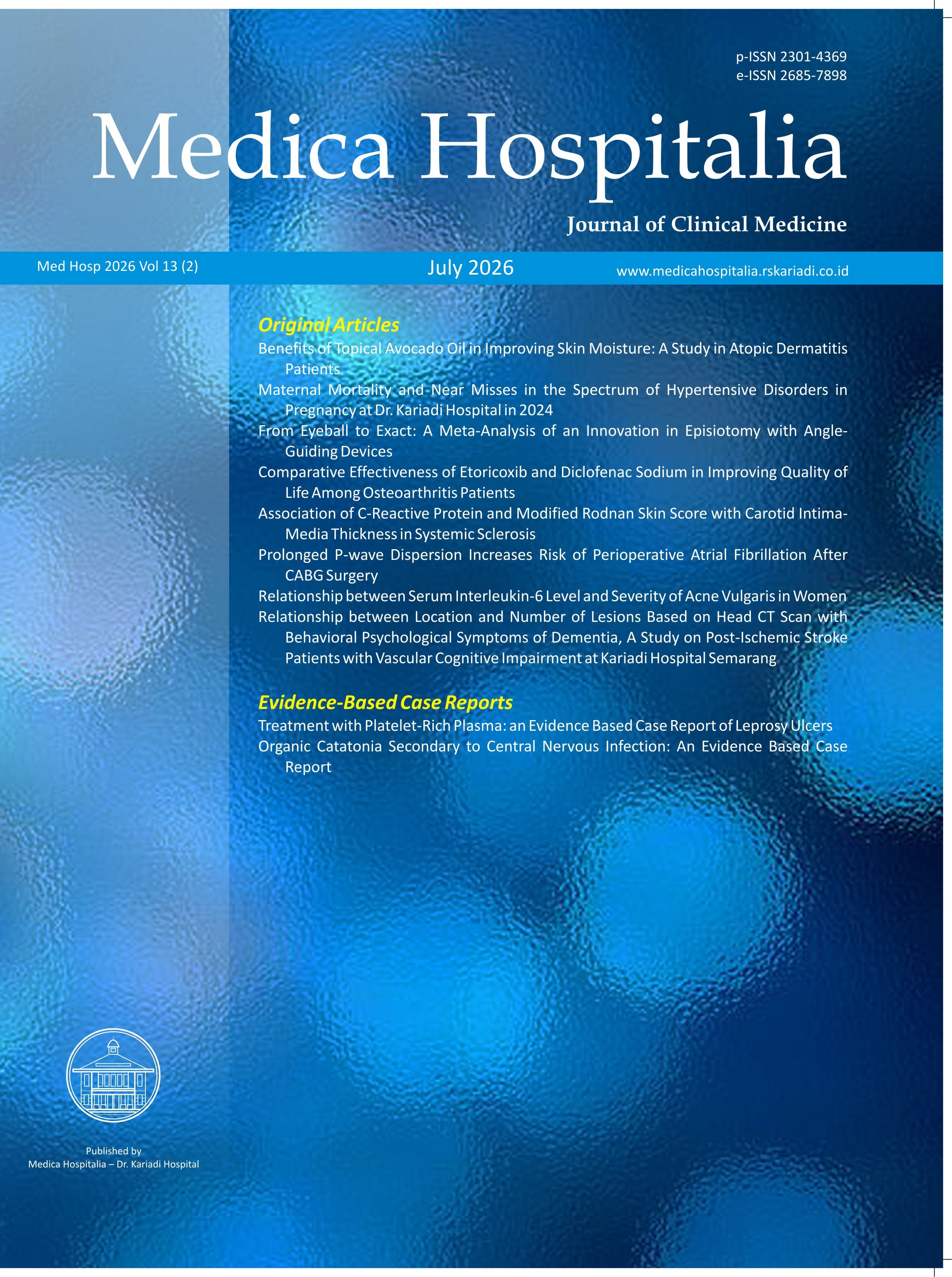
From Eyeball to Exact: A Meta-Analysis of an Innovation in Episiotomy with Angle-Guiding Devices
DOI:
https://doi.org/10.36408/mhjcm.v13i2.1474Keywords:
Episiotomy angle, Guided Episiotomy, Mediolateral Episiotomy, Meta Analysis, Obstetric Anal sphincter injuryAbstract
BACKGROUND: Episiotomy is a surgical incision performed to enlarge the vaginal outlet during childbirth, but an inaccurate mediolateral angle may increase the risk of obstetric anal sphincter injury (OASIS).
SCOPE: This systematic review focused on randomized controlled trials evaluating dedicated angle-guiding devices for mediolateral episiotomy, including Episcissors-60, Episioguide, and the Episiometer.
AIMS: To compare guided episiotomy devices with conventional eyeball technique in achieving appropriate episiotomy angles and reducing OASIS.
METHOD: A systematic search of PubMed, ScienceDirect, and Wiley was conducted according to PRISMA 2020 principles. Eligible studies included women undergoing vaginal birth in whom a guided device was compared with conventional scissors or routine practice. The primary outcome was post-suture episiotomy angle. Secondary outcomes were OASIS incidence, incision characteristics, pain, practical limitations, and risk of bias.
RESULT: Four randomized controlled trials involving 543 participants were included. Guided devices produced higher post-suture episiotomy angles than conventional technique (standardized mean difference 0.88, 95% CI 0.69-1.06; Z = 9.33; P<0.00001), slthough heterogeneity was substantial (I2=97%). Based on the pooled contingency table, OASIS was more frequent in the eyeball group than in guided group (OR 4.85, 95% CI 1.38-17.07; P-=0.0069)
CONCLUSION: Angle-guiding devices may improve episiotomy angle accuracy and may reduce OASIS risk, but the evidence remains limited by few trials, sparse OASIS event, indirect comparisons between devices, and substantial heterogeneity.
Downloads
References
1. Globerman D et al. Guideline No. 457: Obstetrical Anal Sphincter Injuries (OASIS) Part I: Prevention, Recognition, and Immediate Management. J Obstet Gynaecol Canada [Internet]. 2024 Dec 1;46(12). Available from: https://doi.org/10.1016/j.jogc.2024.102719
2. Djusad S et al. Analysis of episiotomy incidence and risk factors in vaginal deliveries : a single-center. AJOG Glob Reports [Internet]. 2024;4(3):100371. Available from: https://doi.org/10.1016/j.xagr.2024.100371
3. Yang J, Bai H. Knowledge, attitude and experience of episiotomy practice among obstetricians and midwives: a cross-sectional study from China. BMJ Open. 2021 Apr;11(4):e043596.
4. Meo MLN. Antepartum Perineal Massages is Effective to Prevent Intrapartum Perineal Rupture. Indones J Obstet Gynecol. 2020;8(4):258–61.
5. Althaher FF et al. Incidence and risk factors of obstetric anal sphincter injuries: a retrospective study. Ann Saudi Med [Internet]. 2025;45(6):395–405. Available from: https://www.annsaudimed.net/doi/abs/10.5144/0256-4947.2025.395
6. Gachon B et al. Episiotomy to prevent obstetric anal sphincter injuries during instrumental delivery in nulliparous women: a national prospective comparative cohort study. Am J Obstet Gynecol [Internet]. 2025 Aug 1;233(2):123.e1-123.e24. Available from: https://doi.org/10.1016/j.ajog.2025.01.029
7. Houlbracq R et al. Episiotomies and obstetric anal sphincter injuries following a restrictive episiotomy policy in France: An analysis of the 2010, 2016, and 2021 National Perinatal Surveys. PLoS Med. 2025;22(1):1–16.
8. Jamal R et al. Incidence and risk factors of obstetric anal sphincter injuries: a retrospective study. Ann Saudi Med [Internet]. 2025;45:123–30. Available from: https://www.annsaudimed.net/doi/epdf/10.5144/0256-4947.2025.395?utm_source=chatgpt.com
9. Packet B et al. Predictive factors for obstetric anal sphincter injury in primiparous women : systematic review and meta-analysis. 2023;(June):486–96.
10. Dwan K et al. Perineal techniques during the second stage of labour for reducing perineal trauma and postpartum complications (Review). Cochrane Database Syst Rev. 2024;
11. Fernando R et al. Detection of obstetric anal sphincter injuries: From the fear of malpractice to a quality indicator of a center. Int J Gynecol Obstet. 2025;(July):1–7.
12. Okeahialam NA et al. Mediolateral/lateral episiotomy with operative vaginal delivery and the risk reduction of obstetric anal sphincter injury (OASI): A systematic review and meta-analysis. Int Urogynecol J. 2022 Jun;33(6):1393–405.
13. Orlando A et al. A systematic review and a meta-analysis on the incidence of obstetric anal sphincter injuries during vaginal delivery. Color Dis [Internet]. 2024 Feb 1;26(2):227–42. Available from: https://doi.org/10.1111/codi.16831
14. Hajhashemi M et al. Evaluation of episiotomy characteristics of episcissors–60 scissors compared with Mayo Scissors: A single-blind randomized clinical trial. Med J Islam Repub Iran [Internet]. 2023;37(1):13–5. Available from: https://journals.sums.ac.ir/
15. Gupta S et al. Evaluation of the ease of use and acceptability of an innovative device - the “Episiometer”, in ensuring an accurate mediolateral episiotomy: a pilot study. J Obstet Gynaecol J Inst Obstet Gynaecol. 2019 Nov;39(8):1065–70.
16. Thanapongpibul C, Suksamarnwong M. Effects of Episioguide – a 60° Mediolateral Episiotomy Guide Device – on Post Suture Episiotomy Angle: A randomized controlled trial. Thai J Obstet Gynaecol. 2022;30(1):7–14.
17. Sawant G, Kumar D. Randomized trial comparing episiotomies with Braun-Stadler episiotomy scissors and EPISCISS ORS-60®. Med Devices Evid Res. 2015;8:251–4.
18. Sriram SN et al. Obstetric Anal Sphincter Injury After Episiometer-Guided Versus Conventional Episiotomy in Instrumental Deliveries: A Randomized Controlled Trial. Int Urogynecol J [Internet]. 2024;35(12):2375–83. Available from: https://doi.org/10.1007/s00192-024-05917-x
19. Page MJ et al. The PRISMA 2020 statement : an updated guideline for reporting systematic reviews Systematic reviews and Meta-Analyses. 2021;
20. Connell SO et al. Episcissors ‑ 60 for Mediolateral Episiotomy : Evaluation of Clinical and Economic Evidence to Inform NICE Medical Technologies Guidance. Appl Health Econ Health Policy [Internet]. 2022;20(2):159–69. Available from: https://doi.org/10.1007/s40258-021-00695-9
21. van der Lugt B, Harvey N, Woolley T, Gupta S, Inania M, van Santen B et al. Category – Urogynaecology and Pelvic Floor Medicine [Internet]. Vol. 126, BJOG: An International Journal of Obstetrics & Gynaecology. 2019. 227–238 p. Available from: https://obgyn.onlinelibrary.wiley.com/doi/abs/10.1111/1471-0528.22_15703
22. Shalabna E. How time in fl uences episiotomy utilization and obstetric anal sphincter injuries ( OASIS ). J Perinat Med [Internet]. 2025;53(1):67–72. Available from: https://doi.org/10.1515/jpm-2024-0254
23. Ankarcrona V et al. Obstetric anal sphincter injury after episiotomy in vacuum extraction: an epidemiological study using an emulated randomised trial approach. BJOG [Internet]. 2021;128:1663–71. Available from: https://obgyn.onlinelibrary.wiley.com/doi/pdf/10.1111/1471-0528.16663?utm_source=chatgpt.com
24. Eggebø TM et al. Long‑term effect of implementing perineal protection and lateral episiotomy on OASIS rates (1999–2021). Acta Obs Gynecol Scand [Internet]. 2024;103:488–97. Available from: https://obgyn.onlinelibrary.wiley.com/doi/pdf/10.1111/aogs.14742?utm_source=chatgpt.com
25. Freeman RM et al. Cutting a mediolateral episiotomy at the correct angle: evaluation of a new device, the Episcissors-60. Med Devices (Auckl). 2014;7:23–8.
26. Morganelli G et al. European Journal of Obstetrics & Gynecology and Reproductive Biology Role of mediolateral or lateral episiotomy in preventing obstetric anal sphincter injury ( OASI ) in nulliparous women undergoing vacuum-assisted delivery : A systematic review and meta-analysis. Eur J Obstet Gynecol Reprod Biol [Internet]. 2026;318(January):114939. Available from: https://doi.org/10.1016/j.ejogrb.2026.114939
27. Wilopo S et al. Bringing Private Midwives into Indonesia’s National Health Insurance Scheme: A Landscape Analysis. Washington, DC Univ Gadjah Mada ThinkWell [Internet]. 2020;(July). Available from: www.thinkwell.global
Additional Files
Published
How to Cite
Issue
Section
License
Copyright (c) 2026 Surahman Hakim, Bimanugraha Bimanugraha, Valencia Hadinata, Adib Kamal, Tha’atam Mardhiyah (Author)

This work is licensed under a Creative Commons Attribution-ShareAlike 4.0 International License.
Copyrights Notice
Copyrights:
Researchers publishing manuscrips at Medica Hospitalis: Journal of Clinical Medicine agree with regulations as follow:
Copyrights of each article belong to researchers, and it is likewise the patent rights
Researchers admit that Medica Hospitalia: Journal of Clinical Medicine has the right of first publication
Researchers may submit manuscripts separately, manage non exclusive distribution of published manuscripts into other versions (such as: being sent to researchers’ institutional repository, publication in the books, etc), admitting that manuscripts have been firstly published at Medica Hospitalia: Journal of Clinical Medicine
License:
Medica Hospitalia: Journal of Clinical Medicine is disseminated based on provisions of Creative Common Attribution-Share Alike 4.0 Internasional It allows individuals to duplicate and disseminate manuscripts in any formats, to alter, compose and make derivatives of manuscripts for any purpose. You are not allowed to use manuscripts for commercial purposes. You should properly acknowledge, reference links, and state that alterations have been made. You can do so in proper ways, but it does not hint that the licensors support you or your usage.