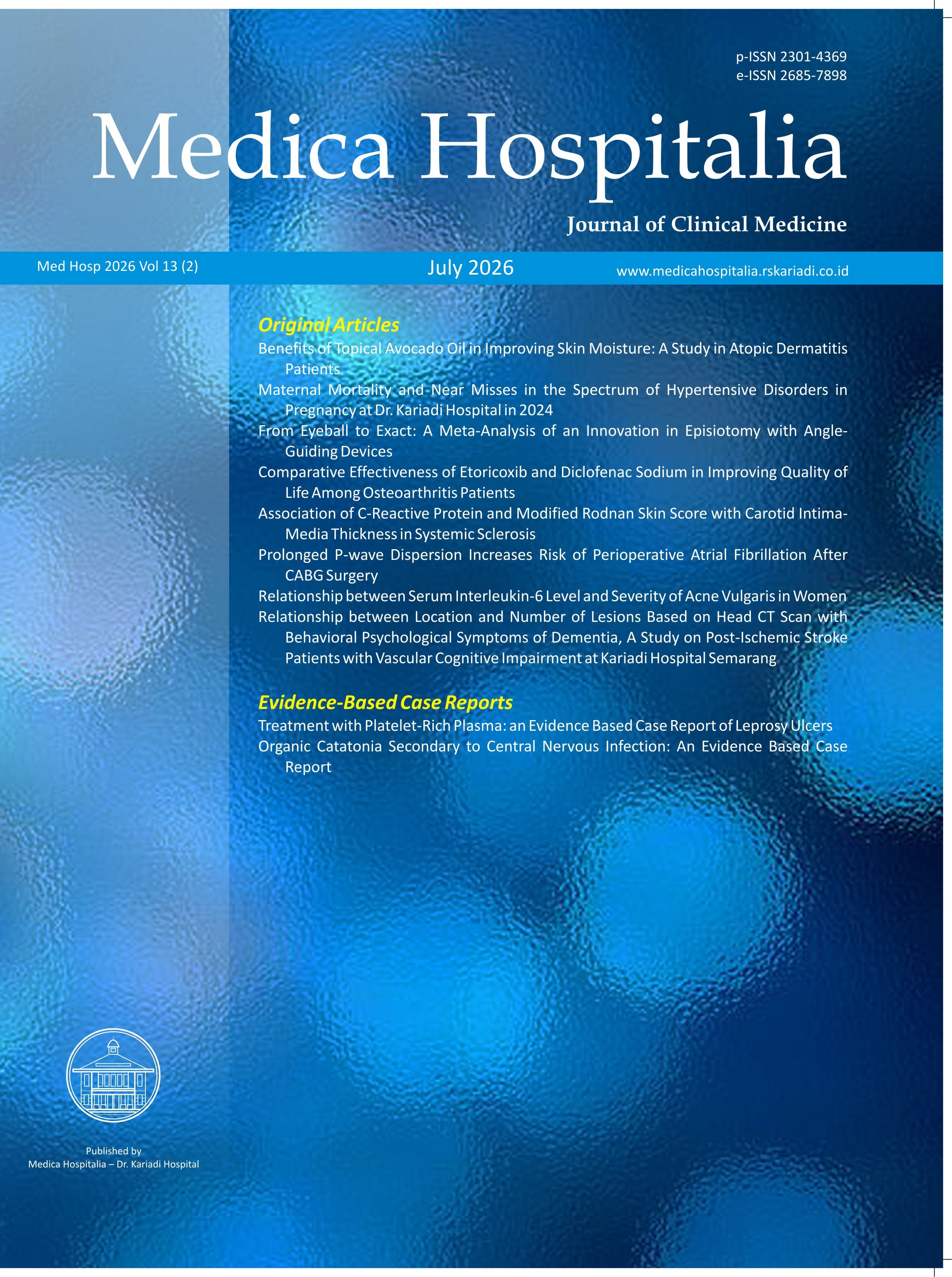
Prolonged P-wave Dispersion Increases Risk of Perioperative Atrial Fibrillation After CABG Surgery
DOI:
https://doi.org/10.36408/mhjcm.v13i2.1475Keywords:
Coronary Artery Bypass Graft, P-wave Dispersion, Postoperative Atrial FibrillationAbstract
BACKGROUND : Postoperative Atrial Fibrillation (POAF) is a secondary Atrial Fibrillation caused by cardiac surgical intervention, especially Coronary Artery Bypass Graft (CABG) Surgery. P-wave dispersion (Pdis) represents the difference between the maximum and minimum P-wave durations obtained from a standard 12-lead ECG. P-wave dispersion is considered a non-invasive ECG marker of atrial remodeling and may predict the occurrence of atrial fibrillation.
AIMS : This study analyzes the association between P-wave dispersion and Perioperative Atrial Fibrillation after Coronary Artery Bypass Graft Surgery.
METHOD : This was an observational, analytic study with a retrospective design. The total number of subjects was 48 patients, divided into the POAF group (n=24) and no POAF group (n=24). Demographic data and preoperative ECG records were obtained from the patient's medical records. The significance of P-wave dispersion was analyzed using independent t-test and logistic regression. The Receiver Operating Characteristic (ROC) test was used to define cut-off values, sensitivity, and specificity of P-wave dispersion.
RESULT : The total number of subjects in this study was 48 patients, consisting of 43 men and five women. The mean age of the patients was 57.85 ± 5.83 years. The mean P-wave dispersion was higher in patients who experienced POAF (64.97 ± 13.21 vs. 50.55 ± 7.14; p<0.001). P-wave Dispersion was significantly associated with the incidence of POAF (p<0.001; cut-off 55.65 ms; OR 9.00; 95% CI 2.437-33.244).
CONCLUSION : P-wave Dispersion is significantly associated with Postoperative Atrial Fibrillation. P-wave dispersion value greater than 55.65 ms increases the risk of POAF after CABG by 9-fold.
Downloads
References
1. Bachtiar A, Candi C, Hasibuan SR, Widyasanti N, Kusuma D. Navigating the aftermath: Risk factors of recurrence following coronary bypass surgery in Indonesia. Narra J. 2024; 4(3): e969. doi: 10.52225/narra.v4i3.969.
2. Bachar BJ, Manna B. Coronary Artery Bypass Graft. In: StatPearls. Treasure Island (FL): StatPearls Publishing; 2023.
3. Nesheiwat Z, Goyal A, Jagtap M. Atrial Fibrillation. In: StatPearls. Treasure Island (FL): StatPearls Publishing; 2023.
4. Shah S, Chalil V, Battisha A, Haq S, Kalra DK. Postoperative Atrial Fibrillation: A Review. Biomedicines. 2024; 12(9): 1968. https://doi.org/10.3390/biomedicines12091968
5. Kumar A, Ranjan R, Adhikary AB. Prevalence of Postoperative Atrial Fibrillation Following Off-Pump Coronary Artery Bypass Graft Surgery in Elderly Patients. Cureus. 2023 Feb 1;15(2):e34499. doi: 10.7759/cureus.34499
6. Lopes, L.A.; Agrawal, D.K. Post-Operative Atrial Fibrillation: Current Treatments and Etiologies for a Persistent Surgical Complication. J. Surg. Res. 2022; 5: 159–72.
7. Jin Ma, Chen Q, Ma S. Left atrial fibrosis in atrial fibrillation: Mechanisms, clinical evaluation and management. J Cell Mol Med. 2021; 25(6):2764–2775. doi: 10.1111/jcmm.16350
8. Gaudino M, Di Franco A, Rong LQ, Piccini J, Mack M. Postoperative atrial fibrillation: From mechanisms to treatment. Eur. Heart J. 2023; 44(12): 1020–39. doi: 10.1093/eurheartj/ehad019
9. Puerta RC, Martinez EL, Donoiu I, Gonzalez EC. P-wave dispersion is a vectorial phenomenon: Is it time to change minds? J Arrhythm. 2022; 38(6):1106-7. doi: 10.1002/joa3.12779
10. Jagannatha GNP, Antara IMPS, Kosasih AM, et al. P-wave peak time and P-wave dispersion in surface electrocardiography as initial predictors of new-onset atrial fibrillation in early-onset hypertension. Hypertens Res. 2024;47(1):137–48. doi: 10.1038/s41440-023-01357-0.
11. Jazi MH, Amirpour A, Zavvar R, Behjati M, Gharipour M. Predictive value of P-wave duration and dispersion in post coronary artery bypass surgery atrial fibrillation. ARYA Atherosclerosis Journal. 2012;8(2):59-62.
12. Chandy J, Nakai T, Lee RJ, Bellows WH, Dzankic S, Leung JM. Increases in P-wave Dispersion Predict Postoperative Atrial Fibrillation after Coronary Artery Bypass Graft Surgery. Anesth Analog. 2004;98(2):303-10. doi: 10.1213/01.ANE.0000096195.47734.2F.
13. Khosropanah S, Nemati MH, Lari B, Zare N. Effect of CABG on P-wave Dispersion and the Relationship between AF and P-wave Dispersion. Int Cardiovasc Res J. 2009;3(2):e68401.
14. Seo EJ, Hong J, Lee HJ, Son YJ. Perioperative risk factors for new-onset postoperative atrial fibrillation after coronary artery bypass grafting: a systematic review. BMC Cardiovasc Disord. 2021; 21(1): 418. doi: 10.1186/s12872-021-02224-x
15. Sahin YB, Seckin Ozden. Predictive Value of P-Wave Dispersion for Paroxysmal Atrial Fibrillation in Healthy Elderly Patients. Arch Curr Med Res 2026; 7(1): 137-144.
16. Erciyes D, Akdeniz E, Yildiz C, Akin B, Ucar FM. Ann Transplant. 2025; 30: e951422. doi: 10.12659/AOT.951422
17. Wang H, Zhang Y, Xin F, Jiang H, Tao D, Jin Y, et al. Calcium-Induced Autonomic Denervation in Patients With Post-Operative Atrial Fibrillation. J Am Coll Cardiol. 2021; 77(1): 57–67. doi: 10.1016/j.jacc.2020.10.049
18. Elliot AD, Middledorp ME, Van Gelder IC, Albert AM, Sansers P. Epidemiology and modifiable risk factors for atrial fibrillation. Nat Rev Cardiol. 2023; 20(6): 404-17. doi: 10.1038/s41569-022-00820-8
19. Sánchez FJ, Pueyo E, Diez ER. Strain Echocardiography to Predict Postoperative Atrial Fibrillation. Int. J. Mol. Sci. 2022; 23: 1355. https://doi.org/10.3390/ ijms23031355
20. Kottkamp H. On the Atrial Fibrillation Substrate: From the “Unknown Species” to Deeper Insights Into Pathophysiology. J Am Coll Cardiol. 2019; 74(10): 1348-51. doi: 10.1016/j.jacc.2019.06.064
21. Xu H, Xu X, Ma J, Zheng S, Song W, Zhong Z, Liu S. Preoperative Risk Factors for Acute Postoperative Atrial Fibrillation in Patients Undergoing Mitral Valve Repair for Degenerative Mitral Regurgitation: Insights Into Cardiac Geometry. Rev Cardiovasc Med. 2025; 26(8):38938. doi: 10.31083/RCM38938.
22. Kallergis EM, Simantirakis EN. Pulmonary Vein Isolation: Cornerstone of Atrial Fibrillation Ablation and Its Evolving Challenges. A Critical Review. Arrhythm Electrophysiol Rev. 2025; 14: e21.https://doi.org/10.15420/aer.2025.20.
23. Kotsialou Z, Makris N, Gall S. Fundamentals of the electrocardiogram and common cardiac arrhytmias. Anaesthesia & Intensive Care Medicine. 2024; 25(3): 219-22. doi: 10.1016/j.mpaic.2023.11.014.
24. Achmad C, Tiksnadi BB, Akbar MR, Karwiky G, Sihite TA, Pramudya A, et al. Left Volume Atrial Index and P-wave Dispersion as Predictors of Postoperative Atrial Fibrillation After Coronary Artery Bypass Graft: A Retrospective Cohort Study. Curr Probl Cardiol. 2023; 48(3): 101031. doi: 10.1016/j.cpcardiol.2021.101031
25. Asrial AA, Reviono R, Soetrisno S, Setianto BY, Widyaningsih V, Nurwati I, Wasita B, Pudjiastuti A. Correlation between circulating fibrosis biomarkers with left atrial function and left atrial volume index in rheumatic mitral stenosis. Narra J. 2024;4(1):e293. doi: 10.52225/narra.v4i1.293
Additional Files
Published
How to Cite
Issue
Section
License
Copyright (c) 2026 Jiauw, Davinarta Yuwono, Pipin Ardhianto, Udin Bahrudin, Ilham Uddin (Author)

This work is licensed under a Creative Commons Attribution-ShareAlike 4.0 International License.
Copyrights Notice
Copyrights:
Researchers publishing manuscrips at Medica Hospitalis: Journal of Clinical Medicine agree with regulations as follow:
Copyrights of each article belong to researchers, and it is likewise the patent rights
Researchers admit that Medica Hospitalia: Journal of Clinical Medicine has the right of first publication
Researchers may submit manuscripts separately, manage non exclusive distribution of published manuscripts into other versions (such as: being sent to researchers’ institutional repository, publication in the books, etc), admitting that manuscripts have been firstly published at Medica Hospitalia: Journal of Clinical Medicine
License:
Medica Hospitalia: Journal of Clinical Medicine is disseminated based on provisions of Creative Common Attribution-Share Alike 4.0 Internasional It allows individuals to duplicate and disseminate manuscripts in any formats, to alter, compose and make derivatives of manuscripts for any purpose. You are not allowed to use manuscripts for commercial purposes. You should properly acknowledge, reference links, and state that alterations have been made. You can do so in proper ways, but it does not hint that the licensors support you or your usage.